
Jigsaw Puzzles
Digital jigsaws with none of the missing-piece anxiety. Pick a picture, choose a piece count and assemble at your own pace — with zoom, edge sorting and progress saved in your browser.
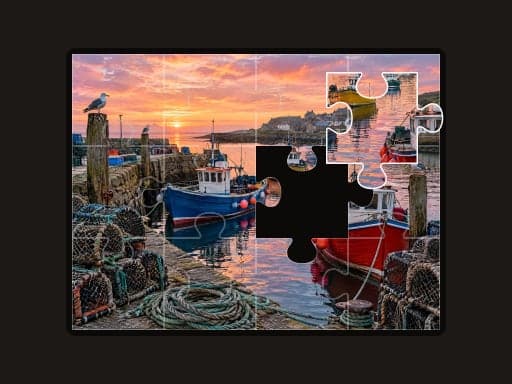
Jigsaws and sliding puzzles
This category covers two related kinds of picture puzzle. Digital jigsaws cut an image into pieces and scatter them, and you rebuild the picture by dragging each piece into place. Unlike a cardboard jigsaw, the digital version usually lets you choose how many pieces to play with, so the same picture can be a five-minute break or a long session. Sliding puzzles take a different approach: the picture is cut into a grid of tiles with one space left empty, and you slide tiles into the gap until the image is back in order.
The two feel very different to play. A jigsaw is about recognising where pieces belong, while a sliding puzzle is about planning a sequence of moves, because every tile you move displaces another.
How to solve a jigsaw faster
Start with the edges. Edge pieces have a straight side and there are fewer of them, so building the border first gives you a frame and a fixed reference for everything inside it. Then sort the rest by colour and texture: sky, water, foliage and faces each form natural groups, and assembling those groups separately is far quicker than trying pieces at random.
Look for areas of strong detail, such as lettering, the edge of a building or a face. Those pieces are the easiest to place and give you anchors in the middle of the picture. Leave large areas of plain colour until last, when there are only a few pieces left to try.
How to solve a sliding puzzle
Sliding puzzles are solved in stages rather than all at once. Complete the top row first, then the left-hand column, and treat the smaller grid that remains as a new puzzle. The last two tiles of any row are the tricky part, because placing one tends to push the other out of position; the usual technique is to set the pair up together, one below the other, and then move them into place as a unit.
A calm kind of challenge
Jigsaws in particular are among the most relaxing puzzles there are. There is no losing, no timer unless you want one, and steady visible progress towards a finished picture, which makes them well suited to winding down at the end of the day. If you enjoy the spatial side, block puzzles offer a similar sense of fitting shapes together.